
Independent Contribution by Heather McCann – this fluid post is not intended to present an opinion about the proposed use of the NERAC facility; it is strictly for information gathering and sharing as it becomes available.
Working Timeline
Last Updated:
Nov 7th 2025 –
In the Executive Session of the State Properties Review Board, the purchase of PRB #25-1000 (303 Merrow Rd) was on the agenda for Discussion Only. Listed on the agenda was a link to their disclosure statement. *No Tolland officials or representatives were notified of the meeting or intention to purchase 303 Merrow Rd.
Nov 12th, 2025 –
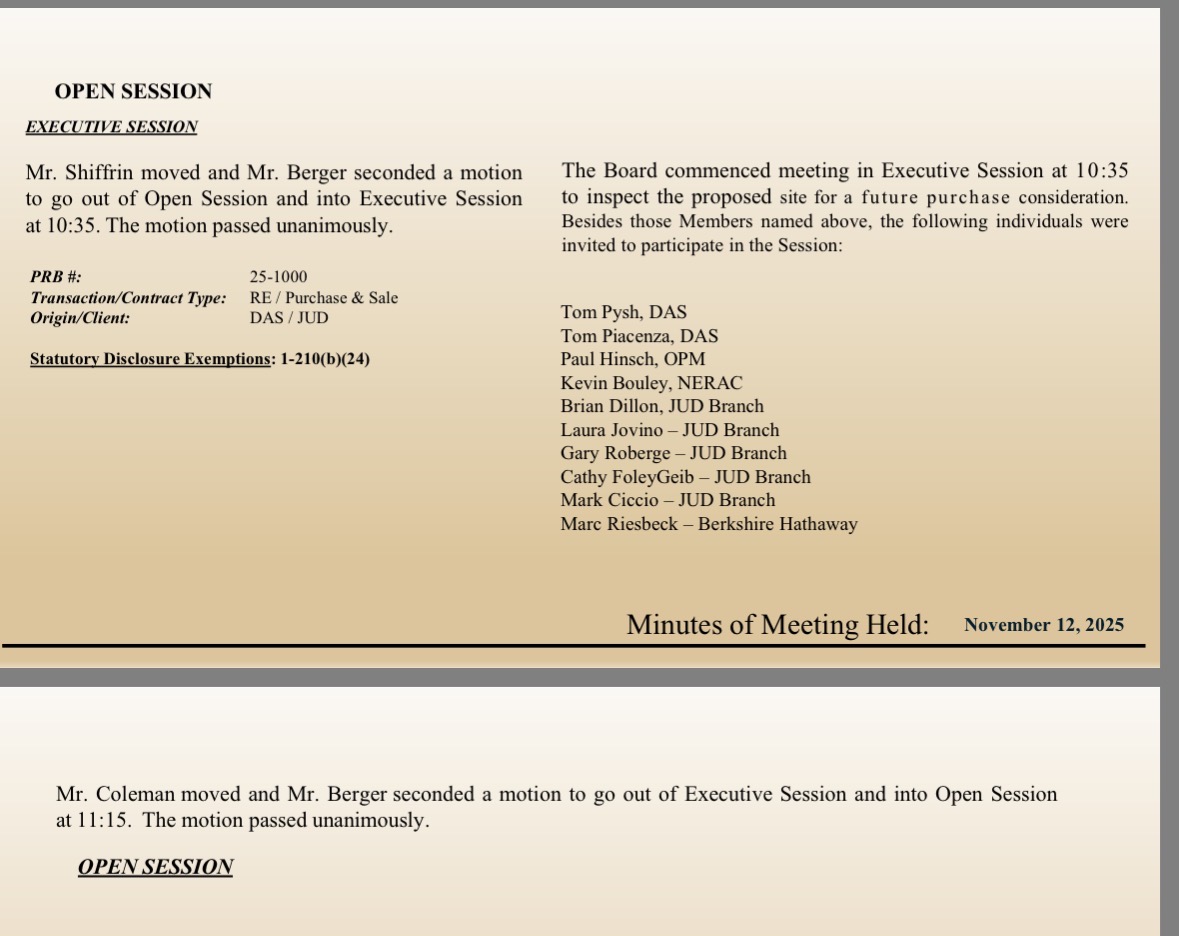
State Properties Review Board held a special closed executive site inspection Meeting at 303 Merrow Road without inviting representatives of Tolland or notifying Tolland officials. The Meeting Minutes can be found here.
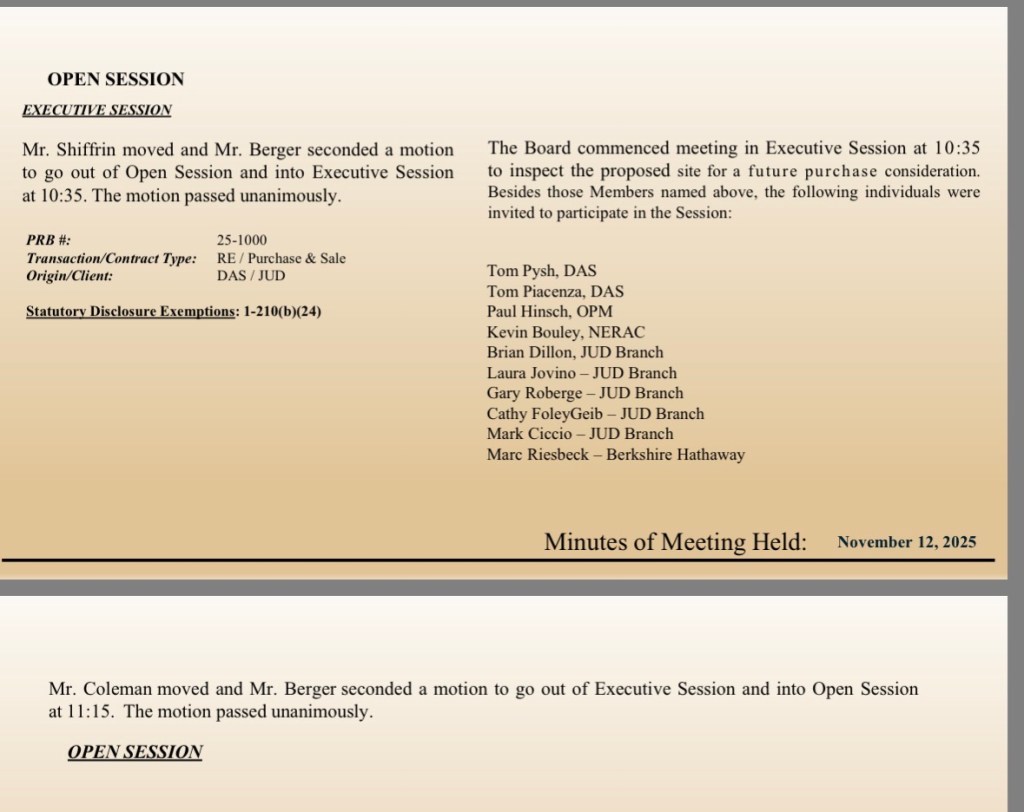
Screenshot February 10th, 2026 –
On Wed Feb 10th, 2026, during the Tolland Town Council meeting, Town Manager Brian Foley announced that he was just made aware that the NERAC property at 303 Merrow Road in Tolland was purchased by the state for the intended use of a REGIONS detention center for “incarcerated youth”. He went on to postulate that these youth will likely be violent criminals.
On Feb 12th, 2026 –
On Feb 12th Senator Jeff Cordon posted on his social media FB account:
“I learned yesterday that the State of Connecticut Judicial Branch signed an agreement to buy property at 303 Merrow Road (Route 195) in Tolland for the purpose to build a 20-bed criminal juvenile detention center. Youth to be housed at this facility would be serious offenders. State government sought this property and made a decision to purchase it completely behind closed doors.” read entire post here.
On Feb 12th the Tolland Democratic Town Committee posted on their social media account the following:
The Tolland Democratic Town Committee believes that strong partnerships between the State of Connecticut and our municipalities depend on transparency, communication, and mutual respect.
We are concerned that town officials and state legislators were not informed earlier about the potential of a juvenile justice facility in Tolland. It is our hope that the State will now provide full and timely information to local officials so they can properly evaluate any potential impacts to the town, economic and otherwise.
Any project of this scale that affects our community deserves open dialogue and the opportunity for residents to ask questions and share their perspectives. Transparency and public input are essential to maintaining trust and ensuring thoughtful decision making.
On Feb 17th, 2026 –
The Patch posted an article: “State Rep, Senator Demanding Documents Regarding Proposal For Juvenile Detection Facility In Tolland”
On Feb 18th, 2026 –
State officials met and agreed to put a “pause” on the juvenile residential facility to allow for further reviews of alternative locations and potential safety concerns.
On Feb 24th, 2026 –
1. The Tolland Town Council held an executive meeting to discuss 303 Merrow Road. AGENDA HERE *note the date on the agenda was incorrect.
2. The Tolland Town Council held a regular meeting and set a date for a Special Public Meeting for March 3, 2026 @ 6:00 pm. For “the purpose of holding a public meeting in regard to the potential State purchase of 303 Merrow Road.” AGENDA HERE
**During public participation and via email to the entire Town Council, I (Heather McCann) requested that representatives from the programs collaborating with the REGIONS programs attend the special public meeting on March 3rd. This is essential so that residents have access to all the information regarding the REGIONS residential facility. Specifically, I am referring to: Community Partners in Action (CPA), ACES (Area Cooperative Educational Services), Connecticut Court Support Services Division (JB-CCSD), and Yale Clinical Services.
Feb 26, 2026
Notice of Postponement of Special Public Meeting
https://www.tollandct.gov/home/news/public-meeting-postponed
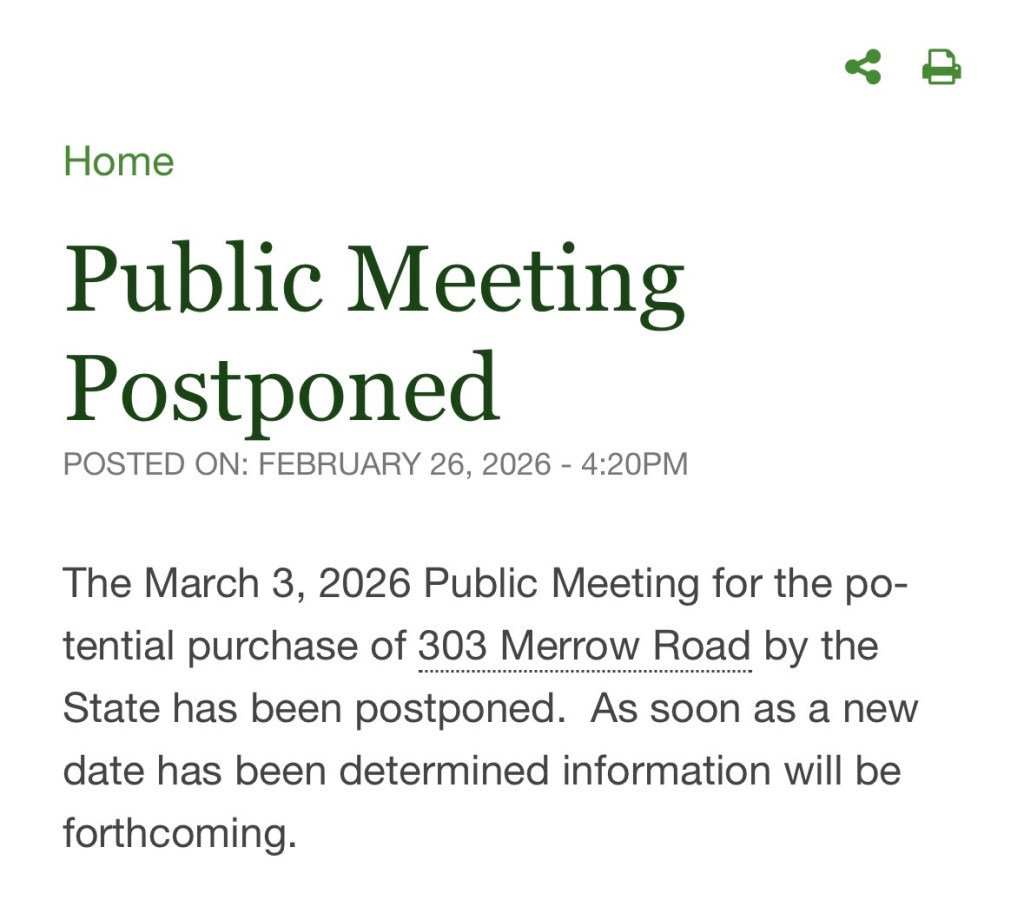
Screenshot Fri Feb 27th
The Patch published an article titled “Tolland Public Meeting on Land Purchase of Juvenile Detention Center Postponed“. In it, Chris Dehnel summarizes the evaluations requested by local lawmakers and Town Manager Foley:
- The potential economic impact of removing a valuable commercial property from
- Tolland’s business corridor.
- A full public safety assessment, including the facility’s proximity to daycare centers,
- residences, and “other community assets.”
- Clarification on operational details, security measures and “long-term implications for the
- town.”
- Infrastructure impacts, including water, sewer and traffic
- A Connecticut General Assembly evaluation
Possible Discrepancy within Patch Article: Article Title refers to the proposed use as a Juvenile Detention Center, but within the article, Chris says this: The 20-bed facility would be part of the CT REGIONS Secure Treatment Program, a therapeutic, staff-secure residential program for court-involved youth (primarily boys aged 14 through 18) operated by the Connecticut Judicial Branch. It offers community-based treatment for six to 12 months, focusing on “trauma-informed care, education, and skill-building to facilitate successful community reintegration. *So which is it?*
Is a Juvenile Detention Center the same as a Therapeutic Residential Facility?
Google: No, a juvenile detention center is not the same as a therapeutic residential facility, although both house minors in secured or supervised settings. Juvenile detention is primarily for short-term custody and secure confinement during court proceedings, while therapeutic residential facilities focus on long-term, individualized treatment for mental health, addiction, or behavioral issues. 
Key differences between the two include:
- Primary Purpose: Detention centers act as “juvenile halls” for holding youth awaiting court hearings or disposition. Therapeutic facilities focus on rehabilitation and treatment for underlying issues.
- Environment: Detention centers are typically high-security, locked, and restrictive. Therapeutic facilities may range from locked to unlocked environments tailored to the youth’s treatment needs.
- Length of Stay: Detention is usually short-term. Therapeutic treatment centers are often long-term placements, sometimes lasting several months.
- Focus: Detention centers emphasize safety and security. Therapeutic facilities focus on counseling, therapy, and skill-building.
Connecticut Judicial Branch (.gov) +6
While some juvenile detention centers may offer therapeutic components, they are primarily designed for safety and securing a juvenile for court, whereas therapeutic residential facilities prioritize rehabilitative care.
What IS REGIONS?
REGIONS
Realizing Educational and Growth Opportunities for Youth in Need of Support
The REGIONS programs collaborate with Community Partners in Action (CPA), ACES (Area Cooperative Educational Services); Connecticut Court Support Service Division (JB-CCSD), Yale Clinical Services .
Community Partners in Action (CPA) – Non-Profit organization focused on behavioral health, criminal justice reform, and re-entry services.
ACES (Area Cooperative Educational Services) – An educational service agency (often a Regional Education Service Center) providing alternative education, special education, and training programs.
Connecticut Court Support Service Division (JB-CCSD) – Responsible for overseeing voluntary and court-ordered residential programs. See Award
Yale Clinical Juvenile Justice Services: Provides on-site, residential, and psychiatric evaluations for youth, often in detention facilities.
Residential Programs for Male Youth
Community Residential Programs are secure, community-based, short-term residential services for delinquents and status offenders.
- What is an Adjudicated Delinquent: Types of Offenses: Most youth arrests are for non-violent offenses. Common offenses include simple assault, disorderly conduct, larceny, vandalism, and drug abuse violations
- What is a Status Offense: A status offense is a noncriminal act that is considered a law violation only because of a youth’s status as a minor. Typical status offenses include truancy, running away from home, violating curfew, underage use of alcohol, and general ungovernability.
These behaviors often signal underlying family or personal issues, shifting the focus toward rehabilitation rather than punitive detention.
The REGIONS program provides up to six months of residential treatment for males aged 14 to 18. It establishes a comfortable, home-like environment that incorporates Dialectical Behavior Therapy alongside culturally diverse services and a supportive atmosphere. The primary objective is to assist these young individuals in reducing their risk factors and preventing involvement in the adult justice system. REGIONS offers a range of comprehensive services, including:
- In-program School
- Vocational Training
- Physical Fitness
- Enrichment Projects
- Mental Health & Medical Care
Focusing on the individual strengths of each participant, the staff facilitates the development of a positive self-image and effective coping skills, fosters positive relationships and personal achievement, and prepares youth to reenter their communities with enhanced capabilities for success. Family members and other supportive individuals in the youth’s life are actively engaged throughout their duration of stay. Furthermore, participants will continue to receive support from REGIONS for several months following their discharge.
Program Locations
REGIONS Hartford
123 Washington Street
Hartford CT 06106
REGIONS Secure Hamden
995 Sherman Avenue
Hamden CT 06514
Are Juvenile Residential Facilities in Ct Tax Exempt?
Some are and some are not. Juvenile residential facilities in Connecticut can be tax-exempt, but it is not automatic. Their tax status depends on their ownership, purpose, and whether they are for-profit or nonprofit.
Is Community Partner Action (who manages REGIONS) a non-profit?
Community Partners in Action is a non-profit agency building community by providing services that promote accountability, dignity and restoration for people affected by the criminal justice system. CPA
Reports and Statistics resources:
Disconnected Youth in Connected Annual Report 2025
Common Misconceptions:
1. All Youth Are Violent or Troubled
- Many believe that all participants are violent or have severe behavioral issues. However, many youth may simply need structure or support.
2. Programs Are Punitive
- Some think residential programs are like prisons; however, they often focus on rehabilitation, education, and personal growth rather than punishment.
3. Lack of Qualified Staff
- There’s a misconception that staff are unqualified or uncaring, but many programs employ trained professionals dedicated to helping youth.
4. No Family Involvement
- People may assume families are excluded, but many programs encourage family participation in the treatment process.
5. Programs Are Ineffective
- Some believe that these programs don’t work; however, many studies show positive outcomes for youth who complete residential treatment.
6. Only for Serious Criminal Offenses
- It’s often thought that only youth with serious criminal histories are admitted, but many participants are there for behavioral issues or family crises.
7. Permanent Placement
- There’s a belief that once a youth enters a residential program, they will stay there indefinitely, but most programs have a defined duration and goals for discharge.
8. Stigmatization
- Many think that attending a residential program will lead to stigma or labeling, but many youth find it a positive turning point in their lives.
9. No Academic Focus
- Some assume that education is not prioritized; in reality, many programs integrate academic support and skill development.
10. Homogeneous Environment
- There’s a misconception that all participants are the same; in reality, programs often serve a diverse group of youth with varying backgrounds and needs.
 Tolland Democratic Town Committee
You must be logged in to post a comment.